
Vietnam Embassy: 6 Essential Services, Complete Guide 2026
Vietnam Embassy is the official diplomatic mission of Vietnam in a foreign country. This guide covers the 6 essential services, how to apply for a visa, required documents, fees, and embassy locations worldwide.
APPLY ONLINE
A Vietnam Embassy is the official diplomatic mission of the Socialist Republic of Vietnam in a foreign country, responsible for issuing visas, providing consular services, and representing Vietnamese government interests abroad. If you plan to visit Vietnam, knowing what your nearest embassy does, and whether you actually need to visit one, prevents delays and last-minute problems at the border.
Specifically, most tourists and short-term business travelers no longer need to set foot in an embassy at all. Since August 2023, Vietnam has opened its e-visa program to citizens of every country, allowing you to apply online and receive your visa by email within 3 working days. However, if you need a work permit visa, a student visa, or a stay longer than 90 days, the embassy remains the correct channel.
Next, even if you qualify for the e-visa, the consular section can still be useful for document authentication, passport renewal for Vietnamese nationals, and notarization of official papers for use in Vietnam. These services are not available online.
Below, this guide covers the 6 main services a Vietnam Embassy offers, how to apply for a visa step by step, what documents you need, current fees and processing times, key embassy locations worldwide, and how the embassy route compares to the online e-visa option.
| Feature | Details |
|---|---|
| Standard processing time | 5-7 working days |
| Expedited processing | 2-3 working days (additional fee applies) |
| Visa fee range | USD 25-130 depending on visa type |
| Application method | In person or by post at your nearest embassy |
| Online alternative | Vietnam e-visa at evisa.gov.vn |
| Appointment required | Yes, at most Vietnam Embassies |
| Vietnam missions worldwide | More than 90 countries |
What Is a Vietnam Embassy?
The Vietnam Embassy is the primary diplomatic office of the Socialist Republic of Vietnam in a foreign country, typically located in the capital city of the host nation. It manages state-to-state relations, processes visa and consular applications, and provides protection and services to Vietnamese nationals living or traveling abroad.
A Vietnam Embassy is distinct from a Vietnam Consulate. The embassy is the main diplomatic mission with the full range of diplomatic and consular powers. Consulates are smaller offices, usually in secondary cities, that handle consular tasks such as visa processing and document authentication, but do not carry out the full diplomatic role. In practice, both can process most types of visa applications. You can apply at whichever location is geographically closest to you.
In countries where Vietnam has no resident diplomatic mission, an embassy in a neighboring country typically has jurisdiction over applications from that region. For example, Vietnam's missions in Thailand and Singapore cover consular requests from several smaller Southeast Asian nations. The official website of each mission will state which embassy has jurisdiction over your country.
What does a Vietnam Embassy handle day to day?
Vietnam Embassies manage two broad categories of work: diplomatic functions and consular functions. Diplomatic functions involve representing the Vietnamese government in the host country, maintaining bilateral relations, and advancing Vietnam's political and economic interests. These activities are led by the Ambassador and senior diplomatic staff and are generally not visible to travelers.
Consular functions are what most travelers and Vietnamese nationals abroad interact with directly. At a typical embassy, consular work includes:
- Processing visa applications for foreign nationals wishing to enter Vietnam.
- Renewing passports and issuing emergency travel documents to Vietnamese nationals.
- Notarizing and authenticating documents for use in Vietnam.
- Registering births, marriages, and deaths of Vietnamese nationals abroad.
- Providing legal assistance and consular protection in emergencies.
- Issuing power of attorney documents for property and legal matters in Vietnam.
The consular section operates during fixed hours, typically Monday to Friday. Most embassies require an appointment for visa submissions and passport services. Check the specific embassy's website for current hours and appointment booking procedures before you visit.
What Services Does a Vietnam Embassy Offer?
There are 6 main services a Vietnam Embassy offers: visa issuance, document authentication, notarization, passport and travel document services, civil registration, and emergency citizen assistance. Each service has its own application process and required documents.
1. Visa issuance
The most common reason foreign nationals contact a Vietnam Embassy is to apply for a visa. The consular section can issue all standard visa types, including tourist (DL), business (DN1, DN2), student (DH), work permit (LD1, LD2), and several specialized long-stay categories.
| Visa type | Code | Purpose | Max stay |
|---|---|---|---|
| Tourist | DL | Tourism, visiting family or friends | 90 days |
| Business | DN1 | Working with established enterprises | 12 months |
| Business | DN2 | Working with newly established enterprises | 12 months |
| Student | DH | Studying at Vietnamese institutions | Up to course length |
| Work permit | LD1 | Skilled labor (with approved work permit) | Up to 2 years |
| Work permit | LD2 | Skilled labor (exempt from work permit) | Up to 2 years |
| Skilled worker | DT1-DT4 | High-skilled investors and specialists | Up to 5 years |
Note: The tourist visa DL is now effectively replaced by the e-visa for most nationalities. If you qualify for the e-visa, applying online through evisa.gov.vn is faster and requires no embassy visit. The embassy route is still needed for DH, LD1, LD2, and DN visa types that the e-visa system does not cover.
2. Document authentication and legalization
The consular section can authenticate foreign documents for use in Vietnam. Authentication confirms that a document is genuine and was issued by a recognized authority. Common documents that travelers and expatriates need authenticated before using them in Vietnam include:
- Birth certificates and family registration books.
- Marriage and divorce certificates.
- University degrees, diplomas, and academic transcripts.
- Police clearance certificates.
- Company registration certificates and business licenses.
- Power of attorney documents.
Authentication generally requires the original document, a certified translation into Vietnamese if the document is not already in Vietnamese, and the authentication fee. Processing takes 3-5 working days in most cases. Some embassies require you to drop off documents in person, while others accept postal submissions.
3. Notarization services
The notarial section can notarize signatures on documents that will be used in Vietnam. Notarization is a separate service from authentication. It confirms the identity of the signatory and the voluntary nature of their signature, but does not confirm the content of the document itself.
You typically need notarization when signing Vietnamese legal documents from abroad, for example: property purchase agreements, power of attorney documents, or company registration papers. You must appear in person for notarization, as the consular officer must witness your signature. The notarization fee varies by embassy and document type.
4. Passport and travel document services
Vietnamese nationals living abroad can renew their passports or apply for emergency travel documents at the nearest mission. Standard requirements include your current passport, completed application forms, passport-sized photos (4x6cm, white background, no glasses), and the applicable fee.
Standard passport renewal takes 15-20 working days and may require forwarding the application to Vietnam's Department of Immigration for processing. Expedited service is available for an additional fee, reducing processing to approximately 7-10 working days. Emergency travel documents, issued when a passport is lost or stolen, can sometimes be processed within 1-3 working days in urgent cases.
5. Civil registration
Vietnamese nationals who are born, married, or registered as deceased while living in a foreign country can register these life events at the nearest embassy. Civil registration ensures the event is recorded in Vietnam's civil registry and that the relevant certificates are legally valid in Vietnam.
Birth registration is particularly important for children born to Vietnamese parents abroad, as it establishes Vietnamese citizenship. The consular section will issue a birth certificate that parents can then use to obtain a Vietnamese passport for the child. Marriage registration is required if a Vietnamese national marries a foreign national abroad and wants the marriage legally recognized in Vietnam.
6. Emergency citizen assistance
The embassy provides emergency assistance to Vietnamese nationals in distress abroad. This includes:
- Issuing emergency travel documents when a passport is lost or stolen.
- Providing consular protection if a Vietnamese national is detained or faces legal proceedings.
- Helping to repatriate Vietnamese nationals who are seriously ill or who have died abroad.
- Facilitating communication with family members in Vietnam during crisis situations.
If you are a Vietnamese national in an emergency abroad, contact the nearest consular section immediately. Most embassies maintain a 24-hour emergency hotline number on their official website for cases outside of regular office hours.
How Do You Apply for a Vietnam Visa at the Embassy?
Applying for a Vietnam visa at the embassy requires 5 steps: confirm requirements with the consular section, prepare your documents, submit your application, pay the fee, and collect your stamped passport. The exact process depends on the specific mission and the visa type you are applying for.
- Confirm requirements with the consular section. Contact your nearest embassy or visit its official website before preparing any documents. Requirements for the same visa type can differ between missions, and some publish updated fee schedules and application forms online. Confirm whether an appointment is required for your submission date.
- Prepare your documents. Gather all required documents based on your visa type (see the full list in the next section). Make sure your passport has at least 6 months remaining validity beyond your planned entry date into Vietnam. Get your passport-sized photos taken: 4x6cm, white background, no glasses, taken within the last 6 months.
- Submit your application. Attend your scheduled appointment at the consular section, or send your documents by post if the mission permits postal applications. Hand in your completed application form and all supporting documents to the consular officer. Keep a copy of everything you submit in case any documents are lost in transit.
- Pay the visa fee. Fees are typically paid at submission time, in local currency or by bank transfer. Keep your payment receipt. Some locations accept credit card payments; others require cash only. Confirm the accepted payment method before you visit, as paying in the wrong form can delay your submission.
- Collect your visa-stamped passport. Return to the consular section (or receive your passport by post if you applied by mail) when your visa is ready. Standard processing takes 5-7 working days. Expedited processing takes 2-3 working days for an additional surcharge. Check that all visa details, including entry and exit type, validity dates, and your passport number, are correct before you leave the counter.
Note: If you find an error on your visa after collection, report it to the consular section immediately. Corrections require additional processing time, so check carefully at the counter rather than discovering a mistake at the port of entry/exit.
What Documents Do You Need for an Embassy Visa?
Document requirements for a Vietnam Embassy visa application depend on your visa type and nationality. For most nationalities, a tourist visa application requires your valid passport, a completed form, passport-sized photos, proof of travel purpose, and the visa fee.
Below is the standard document checklist for a tourist visa (DL) application:
- A passport with at least 6 months validity beyond your intended entry date into Vietnam. The passport must also have at least one blank page for the visa stamp.
- A fully completed Vietnam visa application form. Download the latest version from the specific consular section's official website to make sure you have the correct form, as older versions may be rejected.
- Two (02) passport-sized photos: 4x6cm, white background, no glasses. Photos must have been taken within the last 6 months. The photo must show your full face clearly against a plain white background.
- Proof of travel purpose: confirmed flight bookings and hotel reservations for tourist visits.
- Visa fee in the correct amount and accepted payment method. The fee is non-refundable once submitted.
For business visa (DN1, DN2) applications, you will additionally need:
- An invitation letter from a registered Vietnamese company or guaranteeing agency, stating your name as it appears in your passport, the purpose of the visit, the expected duration of stay, and signed with the legal representative's signature and company seal.
- Copies of the guaranteeing agency's business registration certificate, certified by the company.
For student visa (DH) applications, you will additionally need:
- An official acceptance letter from a Vietnamese university, college, or language school recognized by the Vietnamese Ministry of Education and Training.
- Evidence of sufficient financial means to support yourself during your study period in Vietnam.
For work permit visa (LD1, LD2) applications, you will additionally need:
- An original approval letter issued by the Vietnamese Ministry of Labour, Invalids and Social Affairs, or an original work permit with the ministry's seal.
- A health certificate from a recognized medical facility, issued within the last 6 months.
- A police clearance certificate from your home country, also issued within the last 6 months, confirming no criminal record.
Note: Document requirements change periodically and can vary by nationality. Always verify the current document list directly with the consular section before preparing your application. Submitting an incomplete set of documents leads to delays or rejection. The visa fee is non-refundable in both cases.
What Are the Visa Fees and Processing Times?
Vietnam Embassy visa fees range from approximately USD 25 to USD 130 depending on visa type, entry type, and your nationality. Fees are set by the Vietnamese Ministry of Foreign Affairs and are generally consistent across embassies, though some missions add a small administrative surcharge in local currency.
| Visa type | Entry type | Approx. fee (USD) | Processing time |
|---|---|---|---|
| Tourist (DL) | Single entry | 25-50 | 5-7 working days |
| Tourist (DL) | Multiple entry | 50-95 | 5-7 working days |
| Business (DN1, DN2) | Single entry | 50-95 | 5-7 working days |
| Business (DN1, DN2) | Multiple entry | 95-130 | 5-7 working days |
| Student (DH) | Single entry | 25-50 | 5-7 working days |
| Work permit (LD1, LD2) | Multiple entry | 95-130 | 5-7 working days |
| Any type | Any | +25-50 surcharge | 2-3 working days (expedited) |
The figures above are approximate. The actual fee may differ based on your nationality and the specific mission's fee schedule. Some nationalities receive reduced fees or fee waivers under bilateral agreements between their home country and Vietnam. Confirm the exact fee before you submit your application, as it is non-refundable.
If you need your visa faster than 5-7 working days, ask the consular section about expedited service when you make your appointment. Not all embassies offer this, and availability depends on current staffing levels and seasonal demand. For genuinely urgent travel, the online Vietnam e-visa, which typically processes in 3 working days, may be faster than waiting for embassy expedited service.
Note: The fees listed above are government fees. They do not include any agency fees charged by a third-party service provider if you choose to use one to assist with your application preparation.
Where Are Vietnam Embassies Located?
Vietnam maintains diplomatic missions in more than 90 countries across Asia, Europe, the Americas, Africa, and the Middle East. In countries with a large Vietnamese diaspora or strong bilateral trade ties, Vietnam operates one or more consulates in addition to the main embassy.
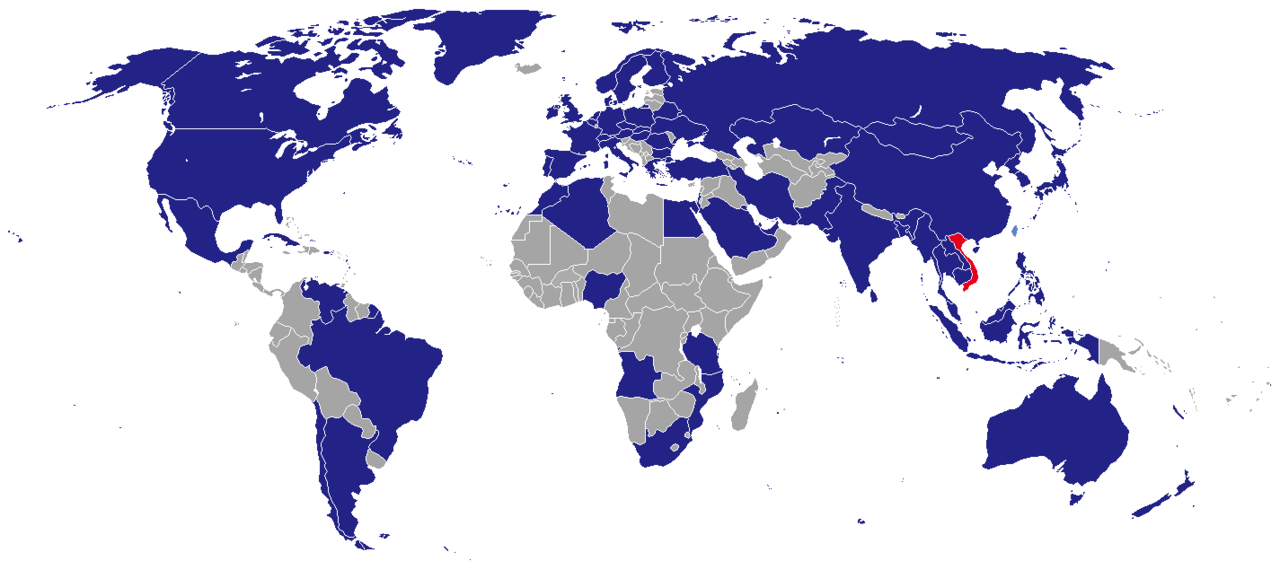
Key locations by region are listed below. Contact details should always be verified on the official website before visiting, as addresses and phone numbers can change.
The Americas
- United States: 1233 20th Street NW, Suite 400, Washington, D.C. 20036. Phone: +1 202 861 0737. Consulates also in San Francisco and New York.
- Canada: 470 Wilbrod Street, Ottawa, Ontario K1N 6M8. Phone: +1 613 236 0772.
- Brazil: SEN, Avenida das Nacoes, Lote 10, Bloco M, Brasilia DF 70432-900. Phone: +55 61 3364 6700.
- Mexico: Sierra Ventana No. 255, Lomas Barrilaco, Mexico City, CP 11010. Phone: +52 55 5540 1632.
Europe
- United Kingdom: 12-14 Victoria Road, London W8 5RD. Phone: +44 20 7937 1912.
- Germany: Elsenstrasse 3, 12435 Berlin. Phone: +49 30 536 3087. Consulate also in Frankfurt.
- France: 62-66 Rue Boileau, 75016 Paris. Phone: +33 1 4515 5000.
- Russia: Bolshaya Pirogovskaya Street 13, Moscow 119435. Phone: +7 495 245 0925.
- Czech Republic: Plzenska 214/26, 150 00 Prague 5. Phone: +420 257 311 108.
Asia-Pacific
- Australia: 6 Timbarra Crescent, O'Malley ACT 2606, Canberra. Phone: +61 2 6286 6059. Consulates also in Sydney and Melbourne.
- Japan: 50-11 Motoyoyogi-cho, Shibuya-ku, Tokyo 151-0062. Phone: +81 3 3466 3311. Consulates also in Osaka and Fukuoka.
- South Korea: 28 Namyeong-dong, Yongsan-gu, Seoul. Phone: +82 2 739 2065.
- India: 17 Kautilya Marg, Chanakyapuri, New Delhi 110021. Phone: +91 11 2301 4056.
- Thailand: 83/1 Wireless Road, Lumpini, Pathumwan, Bangkok 10330. Phone: +66 2 251 5838. Consulate also in Khon Kaen.
- Singapore: 10 Leedon Park, Singapore 267887. Phone: +65 6462 5938.
Middle East and Africa
- Egypt: 1 El-Hafiz Ibrahim Street, Dokki, Cairo. Phone: +20 2 3338 1200.
- South Africa: 87 Brooks Street, Brooklyn, Pretoria 0181. Phone: +27 12 362 8119.
- UAE: Villa No. 58, Al Mushrif Area, Abu Dhabi. Phone: +971 2 449 1700.
If your country is not listed above, visit the Vietnam Ministry of Foreign Affairs website to find the mission with jurisdiction over your region. In countries without a resident embassy, Vietnam's online e-visa system at evisa.gov.vn is generally the most practical option for obtaining entry authorization before you travel.
Vietnam Embassy vs. Online Visa: Which Should You Choose?
The Vietnam Embassy is the right channel when you need a visa type not available online, when you require a stay longer than 90 days, or when your situation needs in-person consular services. For most tourists and short-term visitors, the online Vietnam e-visa is faster, cheaper, and does not require you to leave your passport with the mission for a week or more.
Vietnam's e-visa program was expanded significantly in August 2023. Citizens of all countries are now eligible, and the maximum stay increased to 90 days with single or multiple entry options. For the majority of first-time visitors, the e-visa is the first option to consider before looking at the embassy route.
Vietnam e-visa vs. Vietnam Embassy visa: key differences
| Feature | E-visa (online) | Embassy visa |
|---|---|---|
| Who can apply | All nationalities | All nationalities |
| Application method | Online at evisa.gov.vn | In person or by post |
| Processing time | 3 working days | 5-7 working days |
| Government fee | USD 25 | USD 25-130 (varies by type) |
| Maximum stay | 90 days | Up to 5 years (DT visa types) |
| Entry type | Single or multiple entry | Single or multiple entry |
| Accepted ports | 13 international airports, 16 land borders, 7 seaports | All ports of entry/exit |
| Passport submitted | No | Yes - you submit your physical passport |
When to use a Vietnam Embassy instead of the e-visa
You should apply at the embassy when one or more of the following applies to your situation:
- You need a stay longer than 90 days - the e-visa maximum per visit.
- You are applying for a business visa (DN1, DN2) requiring a guaranteeing agency for an extended work engagement.
- You are applying for a student visa (DH) linked to enrollment at a Vietnamese educational institution.
- You are applying for a work permit visa (LD1, LD2) tied to an approved work permit from Vietnam's Ministry of Labour.
- You are applying for a high-skilled investor or specialist visa (DT1-DT4) with multi-year validity.
- You need document authentication, notarization, or civil registration services.
- You prefer to have a physical visa stamp in your passport before departing your home country.
Note: Visa on arrival is a third option alongside the e-visa and the embassy route. It requires you to obtain an approval letter before travel through a licensed visa agency, then present the letter and pay the visa stamping fee upon arrival at a Vietnamese international airport. Visa on arrival is applicable to air travel only - it is not valid at land border gates or seaports. For most travelers, the e-visa is simpler because it removes the approval letter step and the airport counter queue entirely.
If you are unsure whether your visa type is available through the e-visa system, check our full guide to Vietnam visa types and their application channels, or contact the nearest consular section directly for confirmation before you start preparing documents.
At Vietnamvisa.com, we provide assistance with Vietnam visa applications, including document checklists, form preparation, and application tracking. If you would like help preparing your documents, start your visa application here.
Find Vietnamese embassy in by countries
- Algeria
- Angola
- Argentina
- Australia
- Austria
- Bangladesh
- Belarus
- Belgium
- Brazil
- Brunei
- Bulgaria
- Cambodia
- Canada
- Chile
- China
- Cuba
- Czech Republic
- Denmark
- Egypt
- Finland
- France
- Germany
- Greece
- Hungary
- India
- Indonesia
- Iran
- Israel
- Italy
- Japan
- Kazakhstan
- Kuwait
- Laos
- Malaysia
- Mexico
- Mongolia
- Morocco
- Mozambique
- Myanmar
- Netherlands
- New Zealand
- Nigeria
- North Korea
- Norway
- Pakistan
- Panama
- Philippines
- Poland
- Qatar
- Romania
- Russia
- Saudi Arabia
- Singapore
- Slovakia
- South Africa
- South Korea
- Spain
- Sri Lanka
- Sweden
- Switzerland
- Tanzania
- Thailand
- Turkey
- Ukraine
- United Arab Emirates
- United Kingdom
- United States
- Uzbekistan
- Venezuela
Frequently Asked Questions
If your country has no Vietnam Embassy, apply for the Vietnam e-visa online at evisa.gov.vn - available to all nationalities. Alternatively, identify which embassy has jurisdiction over your country and submit your application there in person or by post.
Standard processing takes 5-7 working days from the date your complete application is received. Expedited processing is available at some embassies for an additional fee, reducing the time to 2-3 working days.
Vietnamese Embassy passport renewal typically takes 3 to 5 business days after all required documents are submitted, though processing time may be longer for lost passport replacements or cases requiring additional background verification.
You need: a passport valid for at least 6 months beyond your entry date, a completed visa application form, two passport-sized photos (4x6cm, white background, no glasses), proof of travel purpose, and the visa fee. Business and work visa applications require additional documents from a Vietnamese guaranteeing agency.