
Vietnam Visa Requirements 2026 - Complete Entry Guide for All Nationalities
Check Vietnam visa requirements for 2026: the full list of 38+ visa-exempt countries by continent, e-visa application steps, stamping fees, and documents needed at the border. Updated to reflect the August 2025 European exemption expansion.
APPLY ONLINE
Not every traveler needs a visa for Vietnam. Vietnam visa requirements depend on your passport nationality: citizens of 38 countries currently enter without a visa for 30 or 45 days, while all other nationalities can apply online for a Vietnam e-visa valid for up to 90 days. Both routes are well-established, and the paperwork for either can be arranged entirely before departure.
For most travelers today, the e-visa is simply how you get into Vietnam. You file your application at evisa.gov.vn and wait 5-7 working days for a decision. Once approved, the visa is valid at all 83 ports of entry - airports, land border gates, and seaports alike (as of December 2025). If your trip can't wait that long, we can process an urgent e-visa for you in as little as 2.5 hours.
If your nationality qualifies for visa-free access, you arrive with only your passport. No advance application, no fees, and no additional paperwork. The exemption covers tourism and short-term business visits but does not permit work or study in Vietnam.
Below, this guide covers the full Vietnam visa requirements by country and continent, how to apply for an e-visa, required documents, fees for 2026, and special cases including the Phu Quoc Island exemption. All data reflects Vietnam's updated entry policy as of August 2025, including the expanded European exemption list.
Vietnam visa requirements in brief:
| Entry type | Validity | Cost | Who qualifies |
|---|---|---|---|
| Visa-free entry | 30 or 45 days | Free | 39 nationalities |
| E-visa (single-entry) | Up to 90 days | USD 25 | All nationalities |
| E-visa (multiple-entry) | Up to 90 days | USD 50 | All nationalities |
| Visa on arrival | Up to 90 days | USD 25-50 stamping fee + agency fee | Air arrivals only |
| Phu Quoc exemption | Up to 30 days | Free | All nationalities (direct arrivals) |
- Do You Need a Visa for Vietnam?
- Vietnam Visa Exemptions by Country and Continent
- How to Apply for a Vietnam E-Visa
- Visa on Arrival: How It Works and What It Costs
- Vietnam Visa Requirements: Documents to Prepare
- Vietnam Visa Fees for 2026
- Phu Quoc Island and Other Special Entry Cases
- Frequently Asked Questions
Do You Need a Visa for Vietnam?
It depends on your passport. Citizens of 38 countries travel to Vietnam without a visa for either 30 or 45 days. For all other nationalities, a Vietnam e-visa covers up to 90 days and is available through the official online portal - no embassy visit required. Your passport must be valid for at least 6 months from your planned entry date regardless of which route you take.
What Decides Which Entry Route You Take?
Three factors shape your options: your nationality, how long you plan to stay, and your port of entry. If you hold a passport from a visa-exempt country and your visit falls within the allowed duration, you enter without any advance visa paperwork. If you plan to stay longer than your exemption allows, or your country is not on the exemption list, you apply for an e-visa or arrange a visa through a Vietnamese consulate before departure.
Your passport also needs at least two blank pages for entry and exit stamps. Immigration officers at Vietnamese ports of entry check both the validity date and the blank page count. Travelers who arrive with a nearly full passport risk being turned back, even with a valid visa or exemption.
Carry printed copies of all documents - approval letters, e-visa print-outs, hotel bookings - rather than relying on a phone screen. Not every checkpoint accepts digital copies, particularly at land border gates.
Can You Extend Your Stay Once You Are in Vietnam?
No, if you entered on a visa exemption. Vietnam does not process extensions for visitors who arrived without a visa. To stay beyond your exemption period, you must leave the country before it expires. You can then re-enter under a fresh exemption or apply for a Vietnam e-visa before returning.
If you entered on an e-visa and need more time, extension eligibility depends on your visa code. Not all e-visa categories allow extension. Check the conditions printed on your approval document and contact a local immigration office in Vietnam if you think you need more time.
What Happens If You Overstay?
Overstaying your permitted duration in Vietnam - whether you entered on a visa exemption, an e-visa, or a stamped visa - results in a fine at the port of exit. The fine is calculated per day of overstay. In more serious cases, immigration authorities may impose a re-entry ban. If you realize you have lost track of your permitted days, report to a local immigration office rather than attempting to exit without paying the fine. The sooner you act, the smaller the penalty.
Vietnam Visa Exemptions by Country and Continent
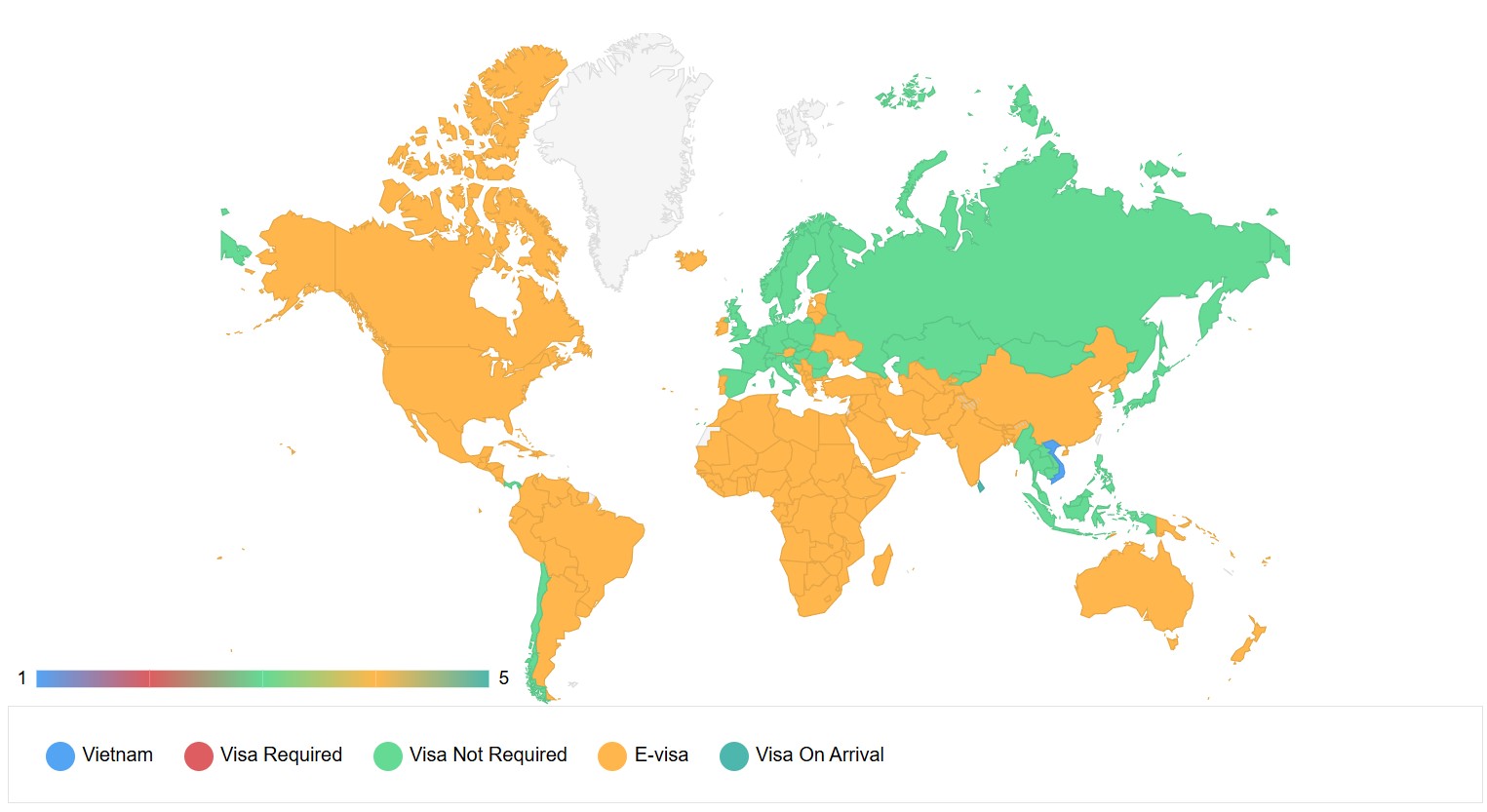
There are 39 countries exempt from Vietnam visa requirements as of 2026, organized across Asia, Europe, South America, and Central America. The tables below are grouped by continent using data from lastest data in 2026.
Asia Visa Exemption Table
| Country | Visa Status | Duration Allowed |
|---|---|---|
| Brunei | Visa not required | 14 days |
| Cambodia | Visa not required | 30 days |
| Indonesia | Visa not required | 30 days |
| Japan | Visa not required | 45 days |
| Kazakhstan | Visa not required | 30 days |
| Kyrgyzstan | Visa not required | 30 days |
| Laos | Visa not required | 30 days |
| Malaysia | Visa not required | 30 days |
| Mongolia | Visa not required | 30 days |
| Myanmar | Visa not required | 14 days |
| Philippines | Visa not required | 21 days |
| Singapore | Visa not required | 30 days |
| South Korea | Visa not required | 45 days |
| Thailand | Visa not required | 30 days |
Countries in Asia that require a visa include China, India, Pakistan, Bangladesh, Sri Lanka, Nepal, Tajikistan, Turkmenistan, Uzbekistan, Azerbaijan, Armenia, Georgia, East Timor, Maldives, and North Korea. Citizens of these nations must apply for an E Visa or other visa type prior to travel.
Europe Visa Exemption Table
| Country | Visa Status | Duration Allowed |
|---|---|---|
| Belarus | Visa not required | 45 days |
| Belgium | Visa not required | 45 days |
| Bulgaria | Visa not required | 45 days |
| Croatia | Visa not required | 45 days |
| Czech Republic | Visa not required | 45 days |
| Denmark | Visa not required | 45 days |
| Finland | Visa not required | 45 days |
| France | Visa not required | 45 days |
| Germany | Visa not required | 45 days |
| Hungary | Visa not required | 45 days |
| Italy | Visa not required | 45 days |
| Luxembourg | Visa not required | 45 days |
| Netherlands | Visa not required | 45 days |
| Norway | Visa not required | 45 days |
| Poland | Visa not required | 45 days |
| Romania | Visa not required | 45 days |
| Russia | Visa not required | 45 days |
| Slovakia | Visa not required | 45 days |
| Slovenia | Visa not required | 45 days |
| Spain | Visa not required | 45 days |
| Sweden | Visa not required | 45 days |
| Switzerland | Visa not required | 45 days |
| United Kingdom | Visa not required | 45 days |
European countries that currently require a visa include Austria, Bosnia and Herzegovina, Estonia, Gibraltar, Greece, Greenland, Iceland, Ireland, Latvia, Lithuania, Macedonia, Malta, Moldova, Montenegro, Portugal, Scotland (British Overseas Territory), Serbia, and Ukraine. Citizens of these countries should use the Vietnam E Visa system before traveling.
South America Visa Exemption Table
| Country | Visa Status | Duration Allowed |
|---|---|---|
| Chile | Visa not required | 90 days |
All other South American countries Argentina, Bolivia, Brazil, Colombia, Ecuador, Guyana, Paraguay, Peru, Suriname, Uruguay, Venezuela, and the Falkland Islands require a visa to enter Vietnam. The E Visa is available to all of these nationalities.
Central America and Caribbean Visa Exemption Table
| Country | Visa Status | Duration Allowed |
|---|---|---|
| Panama | Visa not required | 90 days |
All other Central American and Caribbean nations including Costa Rica, Honduras, Guatemala, Nicaragua, El Salvador, Jamaica, Barbados, Belize, Bahamas, Dominican Republic, and Cuba require a visa. The E Visa covers all of these nationalities.
Africa, Middle East, North America & Oceania
All countries in Africa listed on the official Vietnam visa requirement database require a visa. These include Algeria, Angola, Egypt, Morocco, Nigeria, South Africa, Tanzania, and Tunisia.
All countries in the Middle East require a visa, including Qatar, Saudi Arabia, and the United Arab Emirates.
All countries in North America require a visa including the United States, Canada, and Mexico. American, Canadian, and Mexican citizens are all eligible for the Vietnam E Visa.
All countries in Oceania require a visa, including Australia, New Zealand, Fiji, Papua New Guinea, Vanuatu, and Samoa. Australian and New Zealand passport holders may apply for the E Visa online.
How to Apply for a Vietnam E-Visa
Applying for a Vietnam e-visa takes five steps and is processed entirely online. You do not need to visit an embassy or post any physical documents. Processing typically takes 3 working days, though some applications take up to 5 working days during peak travel periods.
Documents You Need Before You Start
- A passport with at least 6 months of remaining validity from your planned entry date
- A clear scan of your passport bio page in JPEG format
- A passport photo in JPEG format (4x6cm, white background, no glasses)
- A valid international credit or debit card: USD 25 for single-entry, USD 50 for multiple-entry
- A confirmed temporary address in Vietnam: hotel name, homestay, or contact address of family or acquaintances
Step-by-Step E-Visa Application Process
- Go to evisa.gov.vn, Vietnam's official government e-visa portal.
- Select your nationality and your intended port of entry from the dropdown menus.
- Fill in the online application form with your personal details, travel dates, and address in Vietnam.
- Upload your passport bio page scan and your passport photo (4x6cm, white background, no glasses).
- Pay the fee: USD 25 for single-entry or USD 50 for multiple-entry using an international credit or debit card.
- Wait for your e-visa approval by email. Most applicants receive it within 3 working days.
- Print the e-visa approval document and carry it with your passport at the port of entry upon arrival.
If your trip can't wait that long and you need Vietnam E-visa in hours. We can process an urgent e-visa for you in as little as 2.5 hours.
Note: The e-visa is not extendable once issued. If you need to stay longer than the approved duration, you must exit Vietnam and re-apply from outside the country.
The e-visa is accepted at 83 ports of entry as of December 2025, including all major international airports, most international land border gates, and several designated seaports. If you plan to enter via a specific land border crossing, confirm that crossing is on the approved list at evisa.gov.vn before purchasing transport.
Visa on Arrival: How It Works and What It Costs
Visa on arrival is available to all nationalities but applies only to travelers arriving by air. Despite the name, you cannot show up at a Vietnamese airport without any prior preparation. The process has two distinct stages: an approval letter arranged before departure, followed by a visa stamp obtained at the airport counter upon arrival.
How the Process Works
Before you fly, you arrange a pre-approved visa letter through a licensed travel agency. Service fees typically range from USD 20 to USD 50. VietnamVisa.com backs every application with a money-back guarantee if your application is declined, we refund the full amount you paid (excluding declines caused by incorrect information you supplied). On arrival at one of three qualifying airports, you present the letter at the dedicated visa-on-arrival counter, pay the stamping fee in cash, and receive your entry stamp. The full process at the airport usually takes 15-30 minutes, longer during busy periods.
Visa on arrival is processed at these three airports only:
- Noi Bai International Airport, Hanoi
- Da Nang International Airport
- Tan Son Nhat International Airport, Ho Chi Minh City
It is not available at land border gates or seaports. If you arrive overland, you need a valid e-visa or a visa issued in advance by a Vietnamese embassy or consulate. The e-visa is generally the more convenient choice for overland travelers because it is accepted at 83 ports of entry, including international land border crossings. For a full list of approved land border crossings and agency recommendations, see our Vietnam visa on arrival guide.
Stamping Fee at the Airport
The visa stamping fee is a government charge paid in cash at the airport immigration counter upon arrival. Cards are not accepted at the stamping counter. You can pay in USD or Vietnamese Dong (VND).
| Entry type | Stamping fee (cash only) |
|---|---|
| Single-entry | USD 25 |
| Multiple-entry | USD 50 |
This stamping fee is separate from the agency fee you paid for the approval letter. For most travelers comparing options, the Vietnam e-visa at USD 25-50 total is cheaper than visa on arrival once the agency fee is added. The e-visa also removes the risk of airport queue delays at the stamping counter.
Vietnam Visa Requirements: Documents to Prepare
Vietnam immigration checks your documents at the port of entry regardless of your entry method. The core Vietnam visa requirements for document preparation are consistent across most entry routes, with a few additions depending on whether you hold an e-visa, a visa on arrival letter, or a visa exemption.
Core Documents Required for All Travelers
- A passport valid for at least 6 months from your planned entry date into Vietnam
- At least 2 blank pages in your passport for entry and exit stamps
- Proof of a return or onward ticket (airlines and immigration commonly request this at check-in and at the border)
- Proof of accommodation or a contact address in Vietnam: hotel confirmation, homestay booking, or a host's address
Additional Documents for E-Visa Holders
- Your printed e-visa approval letter (digital copies on a phone screen may not be accepted at every checkpoint)
- The international payment card used to pay for the e-visa (some counters verify the card against the application)
Additional Documents for Visa on Arrival
- Your printed pre-approved visa letter issued by the agency
- Two passport-sized photos (4x6cm, white background, no glasses)
- The stamping fee in cash: USD 25 for single-entry or USD 50 for multiple-entry, in USD or VND
Note: Specific Vietnam visa requirements can vary slightly by port of entry and by individual immigration officer. Printing every document gives you the most reliable experience. If you are crossing an international land border, confirm in advance that your specific visa type is accepted at that crossing - not all visa codes are valid at all land gates. For a breakdown of document requirements by visa type and nationality, visit our Vietnam e-visa requirements checklist.
Vietnam Visa Fees for 2026
Vietnam charges fixed government fees for e-visas and a government stamping fee for visa on arrival. Travelers entering on a visa exemption pay nothing. Embassy and consulate fees vary by country and are set by individual Vietnamese missions abroad.
| Visa type | Component | Amount |
|---|---|---|
| E-visa - single-entry (up to 90 days) | Government fee | USD 25 |
| E-visa - multiple-entry (up to 90 days) | Government fee | USD 50 |
| Visa on arrival - single-entry | Agency approval letter | USD 20-50 (varies) |
| Visa on arrival - single-entry | Airport stamping fee | USD 25 |
| Visa on arrival - multiple-entry | Airport stamping fee | USD 50 |
| Visa exemption | None | Free |
The e-visa fee is non-refundable once submitted. If your application is rejected, the fee is not returned. Review your application details carefully before payment. For visa on arrival, the stamping fee is non-refundable whether or not you are admitted through the immigration counter.
If you need a visa issued at a Vietnamese embassy or consulate - for a work visa, study visa, or another long-stay category - contact the Vietnamese embassy in your country for the current fee schedule and processing time. Consulate fees and timelines differ from e-visa and visa on arrival fees.
Vietnam has expanded and revised its visa policy several times since 2023, and the Vietnam visa requirements for specific nationalities do change. Before any international trip, verify the current rules directly at evisa.gov.vn or through a trusted source like Vietnamvisa.com, especially if your nationality falls under a temporary exemption or if you last traveled to Vietnam more than a year ago.
Phu Quoc Island and Other Special Entry Cases
Vietnam has two entry provisions that sit outside the standard visa exemption and e-visa framework: the Phu Quoc Island exemption for direct international arrivals, and separate conditions for holders of diplomatic or official passports.
Phu Quoc Island: 30-Day Visa-Free Entry for All Nationalities
Any foreign passport holder can visit Phu Quoc Island for up to 30 days without a visa, regardless of nationality. This applies when you fly directly to Phu Quoc International Airport from outside Vietnam. You do not need an e-visa or any advance approval for this route. Present your passport at immigration and you are admitted.
If you enter Vietnam at any other port first - Hanoi, Ho Chi Minh City, Da Nang, or a land border - and then travel to Phu Quoc by domestic flight or ferry, the standard Vietnam visa requirements for your nationality apply to your whole trip. The Phu Quoc exemption applies to the island only for travelers arriving directly from abroad. You cannot use this exemption to enter the Vietnamese mainland or extend your stay beyond the island zone.
Diplomatic and Official Passports
Holders of diplomatic or official passports may qualify for longer exemptions or additional entry conditions under bilateral agreements between Vietnam and their specific country. These conditions differ from the standard tourist exemptions listed in this guide and are not covered by the e-visa rules.
Check with your country's foreign ministry or the nearest Vietnamese consulate for the specific terms that apply to your passport type before you travel.
Frequently Asked Questions
You need a passport valid for at least 6 months from your entry date, a JPEG scan of your passport bio page, a passport photo (4x6cm, white background, no glasses), a valid international payment card, and a confirmed address in Vietnam during your stay.
Up to 90 days from your granted entry date. Both single-entry and multiple-entry options are available. The actual duration is confirmed by the immigration officer at your port of entry.
No. Vietnam e-visas cannot be extended. You must exit Vietnam before your visa expires and apply for a new e-visa or re-enter under a visa exemption if your nationality qualifies.
38 countries have visa-free access: 23 European nations including France, Germany, UK, Italy, Spain, Russia, Belarus, and 12 more covered until August 2028; Japan and South Korea at 45 days; all 9 ASEAN countries at 30 days; plus Chile and Panama at 30 days.
No, you do not need a visa and you are eligible for a 30-day visa exemption to visit Phu Quoc Island if:
- Your passport is valid for 6 month at the time of arrival
- You just stay inside the island
The stamping fee is USD 25 for single-entry or USD 50 for multiple-entry, paid in cash at the airport immigration counter upon arrival. This is a non-refundable government charge, separate from the agency fee paid before departure for the approval letter.
No. Vietnam does not process extensions for travelers who entered on a visa exemption. You must leave before your exemption period expires. You can then re-enter under a fresh exemption or apply for a Vietnam e-visa before your next visit for a stay of up to 90 days.
It depends on your nationality. Citizens of 38 countries are visa-exempt for 30 or 45 days. All other nationalities apply for a Vietnam e-visa at evisa.gov.vn, valid up to 90 days, at USD 25 for single-entry.