
Vietnam Visa Exemption 2026: Countries List, Duration and Entry Rules
Vietnam visa exemption covers 39 nationalities in 2026, with stays from 14 to 90 days. Check the full country list and entry conditions before your trip.
APPLY ONLINE
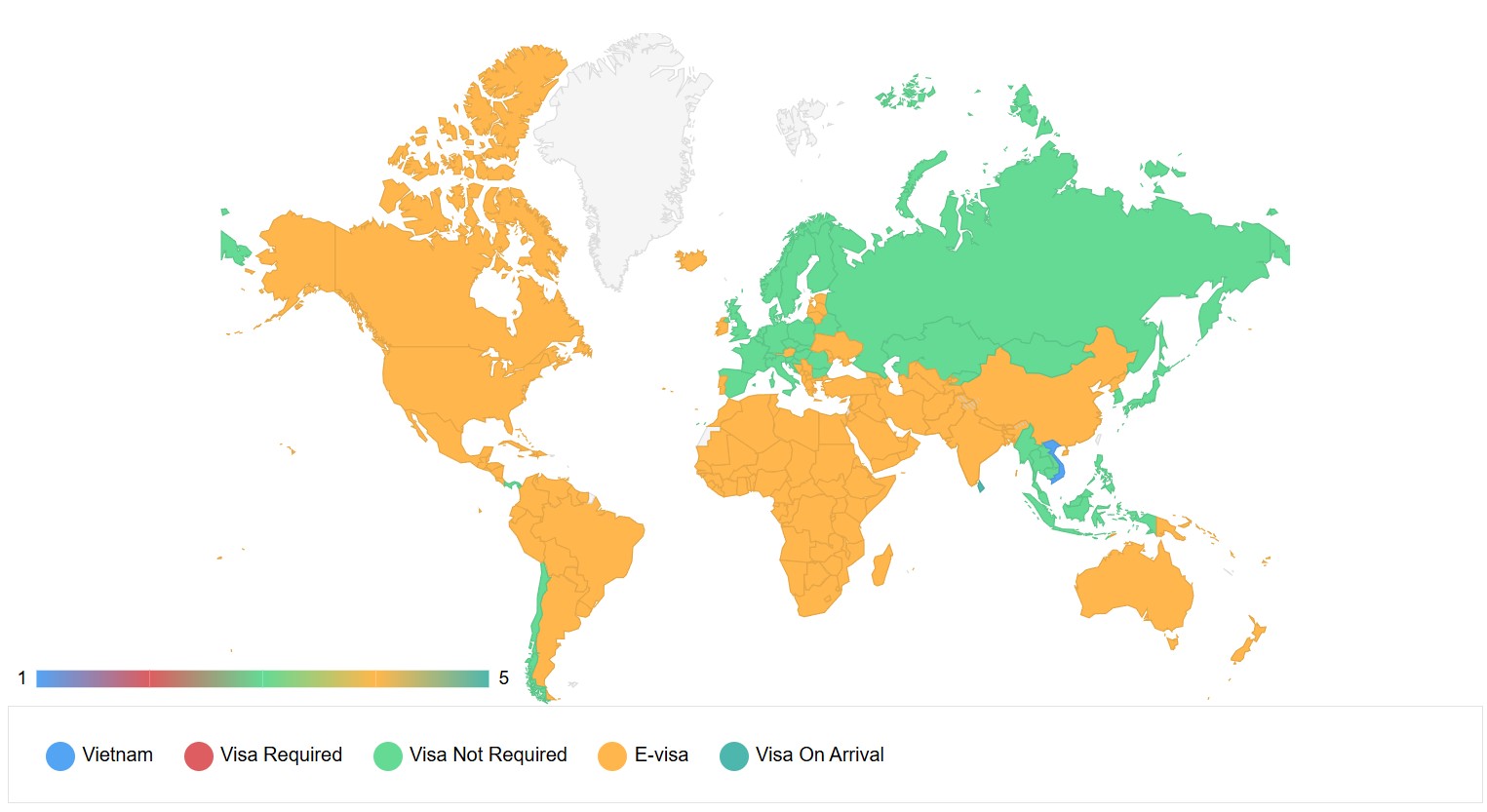
Vietnam visa exemption lets qualifying foreign nationals enter the country without obtaining a visa in advance. As of 2026, 39 nationalities can arrive visa-free, with maximum stays ranging from 14 to 90 days depending on your passport.
The exemption is not the same as the e-visa. If your country is on the list below, you walk through immigration with only your passport. If your country is not on the list, the 90-day Vietnam e-visa is available to all nationalities at evisa.gov.vn for USD 25.
Visa exemption in brief:
| Who qualifies | 39 nationalities (full table below) |
|---|---|
| Maximum stay | 14, 21, 30, 45, or 90 days (by nationality) |
| Entry type | Multiple entry for most nationalities |
| Application required | None - present passport at port of entry |
| Passport validity | At least 6 months beyond your entry date |
| Official portal | evisa.gov.vn |
What is Vietnam visa exemption?
Vietnam visa exemption is the right to enter Vietnam without obtaining a visa before travel. The Vietnamese government grants this right through two mechanisms: bilateral agreements signed with specific partner countries, and unilateral policies that Vietnam applies independently regardless of reciprocity.
Under a bilateral agreement, both countries allow each other's citizens in without a visa. Under a unilateral policy, Vietnam grants access regardless of whether the other country extends the same right to Vietnamese passport holders.
The exemption applies to ordinary passports used for tourism, family visits, or short business meetings. It does not authorize work or study. If you plan to work, your employer must obtain a work permit for you before arrival. If you plan to study, apply for the appropriate student visa at a Vietnamese embassy or consulate.
Two special variants of visa exemption sit outside the standard list: the Certificate of Visa Exemption for overseas Vietnamese and their families, and the Phu Quoc Island visa-free zone for all nationalities. Both are covered in the supplementary section below.
Which Countries Qualify for Visa-Free Entry?
The full list of 39 countries with Vietnam visa exemption in 2026, organized by maximum stay:
| Country | Maximum stay | Entry type |
|---|---|---|
| Chile | 90 days | Multiple |
| Panama | 90 days | Multiple |
| Belgium | 45 days | Multiple |
| Bulgaria | 45 days | Multiple |
| Croatia | 45 days | Multiple |
| Czechia | 45 days | Multiple |
| Denmark | 45 days | Multiple |
| Finland | 45 days | Multiple |
| France | 45 days | Multiple |
| Germany | 45 days | Multiple |
| Hungary | 45 days | Multiple |
| Italy | 45 days | Multiple |
| Japan | 45 days | Multiple |
| Luxembourg | 45 days | Multiple |
| Netherlands | 45 days | Multiple |
| Norway | 45 days | Multiple |
| Poland | 45 days | Multiple |
| Romania | 45 days | Multiple |
| Russia | 45 days | Multiple |
| Slovakia | 45 days | Multiple |
| Slovenia | 45 days | Multiple |
| South Korea | 45 days | Multiple |
| Spain | 45 days | Multiple |
| Sweden | 45 days | Multiple |
| Switzerland | 45 days | Multiple |
| United Kingdom | 45 days | Multiple |
| Belarus | 30 days | Multiple |
| Cambodia | 30 days | Multiple |
| Indonesia | 30 days | Multiple |
| Kazakhstan | 30 days | Multiple |
| Kyrgyzstan | 30 days | Multiple |
| Laos | 30 days | Multiple |
| Malaysia | 30 days | Multiple |
| Mongolia | 30 days | Multiple |
| Myanmar | 30 days | Multiple |
| Singapore | 30 days | Multiple |
| Thailand | 30 days | Multiple |
| Philippines | 21 days | Multiple |
| Brunei | 14 days | Multiple |
Note: Australia, Canada, and the United States are not on the exemption list. Citizens of those three countries must apply for the Vietnam e-visa for every trip to mainland Vietnam.
ASEAN countries and their stay limits
All ASEAN member states have visa-free entry to Vietnam, though stay limits differ by country:
| ASEAN country | Maximum stay | Entry type |
|---|---|---|
| Cambodia | 30 days | Multiple |
| Indonesia | 30 days | Multiple |
| Laos | 30 days | Multiple |
| Malaysia | 30 days | Multiple |
| Myanmar | 30 days | Multiple |
| Singapore | 30 days | Multiple |
| Thailand | 30 days | Multiple |
| Philippines | 21 days | Multiple |
| Brunei | 14 days | Multiple |
Vietnam is itself an ASEAN member, so Vietnamese citizens enter fellow member states under the bloc's reciprocal framework. Of the nine non-Vietnamese ASEAN members, seven receive 30 days, the Philippines receives 21 days, and Brunei receives 14 days.
European Countries and Their Stay Limits
Europe accounts for 23 of the 39 exempt nationalities in 2026. Twenty-two receive 45-day stays, with Belarus on a separate 30-day allowance:
| Country | Maximum stay |
|---|---|
| Belgium | 45 days |
| Bulgaria | 45 days |
| Croatia | 45 days |
| Czechia | 45 days |
| Denmark | 45 days |
| Finland | 45 days |
| France | 45 days |
| Germany | 45 days |
| Hungary | 45 days |
| Italy | 45 days |
| Luxembourg | 45 days |
| Netherlands | 45 days |
| Norway | 45 days |
| Poland | 45 days |
| Romania | 45 days |
| Russia | 45 days |
| Slovakia | 45 days |
| Slovenia | 45 days |
| Spain | 45 days |
| Sweden | 45 days |
| Switzerland | 45 days |
| United Kingdom | 45 days |
| Belarus | 30 days |
One point that catches travelers off guard: being part of the Schengen Area does not automatically qualify you for visa-free entry to Vietnam. The exemption is granted nationality by nationality through specific government decisions. Citizens of Schengen countries not on this list - including Austria, Greece, Ireland, and Portugal - must apply for the Vietnam e-visa.
Other regions: Americas, Asia-Pacific and Middle East
Outside Europe and ASEAN, Vietnam's exemption policy covers a smaller set of nationalities:
- Chile: 90 days, multiple entry. One of the longest exemptions of any nationality.
- Panama: 90 days, multiple entry. Equal to Chile under a bilateral agreement.
- Japan: 45 days, multiple entry.
- South Korea: 45 days, multiple entry.
- Kazakhstan: 30 days, multiple entry.
- Kyrgyzstan: 30 days, multiple entry.
- Mongolia: 30 days, multiple entry.
Australia, Canada, and the United States have no exemption. For Middle Eastern, African, and other Latin American nationalities not mentioned on this page, the Vietnam e-visa - open to all countries worldwide - is the standard route.
How Long Can You Stay?
Your permitted stay depends entirely on your nationality:
- 14 days: Brunei
- 21 days: Philippines
- 30 days: Cambodia, Indonesia, Kazakhstan, Kyrgyzstan, Laos, Malaysia, Mongolia, Myanmar, Singapore, Thailand, Belarus
- 45 days: 22 European countries (see table above), Japan, South Korea
- 60 days: APEC Business Travel Card holders (separate from the standard exemption)
- 90 days: Chile, Panama
How to count your stay: the entry date is Day 1. The exit date is the last day. If you arrive on 1 June with a 30-day exemption, you must leave Vietnam by 30 June at the latest.
Extending a visa-exemption stay is not possible while inside the country. If you need more time, you must exit Vietnam and re-enter for a new exemption period - commonly called a "visa run." Alternatively, apply for the 90-day e-visa at evisa.gov.vn before your next trip. The e-visa takes 3-5 working days to process.
Overstaying your permitted duration is an immigration violation with real consequences. There is no grace period. See the FAQ section below for details on penalties.
Entry Conditions at the Border
Holding a qualifying passport does not guarantee entry. At the port of entry, you must also satisfy these conditions:
- Your passport must be valid for at least 6 months beyond the date you enter Vietnam.
- You must hold a confirmed onward or return ticket out of Vietnam.
- You must have proof of accommodation - a hotel booking, homestay reservation, or an invitation letter from a Vietnamese citizen or registered organization.
- You must not have overstayed a previous Vietnam visa or exemption period.
- You must have sufficient funds for your trip. Immigration officers can ask for evidence; USD 50 per day is a commonly cited benchmark, though no fixed amount is written into law.
The immigration officer at the port of entry has final authority. Entry under visa exemption is a right granted by policy, not an unconditional guarantee. If an officer has reason to doubt your intentions, they can deny entry without stating a specific reason.
If you are denied, you will be placed on the next available flight back to your point of origin. Travel insurance that covers trip disruption is worth holding for this reason.
Single or Multiple Entry?
For almost all qualifying nationalities, the exemption is multiple entry. You can enter Vietnam, leave, and return as often as you want, provided each individual stay does not exceed your permitted duration.
A UK passport holder with 45-day exemption, for example, can fly into Hanoi, spend 40 days traveling, leave to Laos for a few days, then return to Vietnam for a new 45-day period from the re-entry date. There is no minimum gap required between stays.
One practical caveat: if you do very frequent border crossings - arriving, leaving the same day, and returning immediately - immigration officers may suspect you are using the exemption as a substitute for a long-stay visa. They can question your intentions and deny re-entry. The exemption covers tourism and short visits, not long-term residency.
If you plan an extended stay in Vietnam, the 90-day e-visa is a cleaner option than repeated visa runs.
Visa Exemption vs. E-Visa: Which Applies to You?
If your country qualifies for visa exemption, you have a choice for trips up to 45 days. The table below compares both options:
| Visa exemption | Vietnam e-visa | |
|---|---|---|
| Who can use it | 39 nationalities | All nationalities |
| Maximum stay | 14-90 days (by nationality) | 90 days |
| Cost | Free | USD 25 |
| Application | None needed | Online at evisa.gov.vn |
| Processing time | No wait | 3-5 working days |
| Entry type | Multiple (most nationalities) | Single or multiple |
| Stamped in passport | Yes, on arrival | Yes, on arrival |
If you hold a qualifying passport and plan to stay 45 days or fewer, the exemption is simpler - no form, no fee, no waiting. If you need more than 45 days, or if you want a stamped document to show an employer, landlord, or bank as proof of legal status, apply for the e-visa even if exemption applies to your nationality.
US, Canadian, and Australian citizens have no choice: the e-visa is required for every trip to mainland Vietnam.
Certificate of visa exemption for overseas Vietnamese
A Certificate of Visa Exemption (CVE) applies to a specific group: Vietnamese nationals who now hold a foreign passport, and their direct family members - the spouse and children of a Vietnamese-origin person.
The CVE is not a visa. It is a document issued by Vietnamese embassies and consulates that allows the holder to enter Vietnam without a visa for stays of up to 180 days per visit, with unlimited re-entries. The certificate is valid for 5 years, or until 6 months before the holder's passport expiry date, whichever comes first.
To apply, you submit your foreign passport, evidence of Vietnamese origin or family relationship, and the application form at your nearest Vietnamese embassy or consulate. Processing time and required documents vary by location.
Note: the CVE applies only to people of Vietnamese descent or their direct family. If you are a foreign national with no Vietnamese heritage, this document does not apply to you.
Phu Quoc island visa-free zone: 30 days for everyone
Phu Quoc operates under a special visa-free zone policy. Any foreign national who arrives directly to Phu Quoc by air or sea - regardless of nationality - can stay up to 30 days without any visa at all.
This includes nationalities that cannot use the standard exemption for mainland Vietnam. A US or Australian passport holder who wants a short beach trip can fly directly to Phu Quoc and spend up to 30 days without the e-visa. The condition is that you stay on the island. If you travel from Phu Quoc to the Vietnamese mainland during the same trip, you must hold a valid Vietnam e-visa for that portion.
Phu Quoc's exemption covers direct arrivals only. If you enter Vietnam on the mainland first and then travel to Phu Quoc, the island exemption does not apply - your mainland entry conditions govern the trip.
APEC Business Travel Card (ABTC) holders
If you hold a valid APEC Business Travel Card endorsed for Vietnam - look for "VNM" on the back of the card - you qualify for 60-day multiple-entry access without a separate visa.
The ABTC is issued to nationals of APEC economies who travel regularly for business. The card must be valid and must display Vietnam's endorsement. Present it alongside your ordinary passport at the port of entry. Immigration processes ABTC holders in the same lane as standard exempt travelers.
The 60-day ABTC allowance is longer than the 45-day limit that most standard exempt nationalities receive. If you qualify for both, the ABTC is the better option for longer business trips.