
Vietnam Visa Guide for United States Citizens (2026): E-Visa, Visa on Arrival and Embassy
A vietnam visa for United States citizens is required for every standard entry, since US passport holders have no general exemption. Compare the e-visa, visa on arrival, and embassy routes.
APPLY ONLINE
A Vietnam visa for United States citizens is required for every standard entry, since US passport holders have no general visa-free arrangement with Vietnam. You can get one three ways: the online e-visa, visa on arrival at select airports, or a visa sticker from the Vietnamese Embassy in Washington DC or one of its two consulates.
Most travelers pick the e-visa because it skips the embassy visit entirely and covers stays of up to 90 days. If your trip is close, an urgent e-visa service can still deliver approval within hours, which matters given that only one nonstop flight route exists between the United States and Vietnam. Below, you will find the fees, processing time, and document list for each route, plus the passport detail and the one island exception that catch some US applicants off guard.
In brief:
| Processing time | 3-5 working days (standard), from 2.5 hours (urgent) |
|---|---|
| Fee | USD 25 (single entry) / USD 50 (multiple entry) |
| Validity | Up to 90 days |
| Eligible passport | US passport |
| Official site | evisa.gov.vn |
Do US citizens need a visa to enter Vietnam?
Yes. US passport holders are not on Vietnam's visa exemption list, so a visa is required for standard entry through any airport, land border, or seaport, regardless of trip length or purpose. The one exception is Phu Quoc Island's separate 30-day visa-free policy, which applies only to travelers who fly directly into Phu Quoc and go no further; it does not cover entry through Hanoi, Ho Chi Minh City, Da Nang, or any other port.
This distinction trips up some US travelers who read about the Phu Quoc exception and assume it extends to the rest of the country. It does not. If your itinerary includes even one stop outside Phu Quoc, whether on the way in or the way out, you need a visa through one of the three standard routes covered below.
What are the ways to get a Vietnam visa for US citizens?
US citizens have three routes into Vietnam: the e-visa, visa on arrival, and an embassy-issued visa sticker. Each route ends with the same result, a valid visa in your passport or on your approval letter, but the process, fee, and speed differ.
- E-visa: applied for entirely online, no embassy visit, single or multiple entry, up to 90 days.
- Visa on arrival: approval letter obtained online, visa stamped at the airport counter on landing, air travel only.
- Embassy visa: a visa sticker issued by the Vietnamese Embassy in Washington DC or the consulates in San Francisco and Houston.
The e-visa is the fastest of the three for most US travelers, since it removes the in-person step at either end of the trip and works from any US departure city. Visa on arrival can work well if your itinerary lands directly at a Vietnamese airport with a visa counter, but it still leaves the final decision to an immigration officer at the counter rather than settling it before you fly. The embassy visa remains an option mainly for travelers near Washington DC, San Francisco, or Houston who prefer to handle the paperwork in person before departure.
Cost rarely decides between the three routes, since the government fee of USD 25-50 applies whichever way you enter. What separates them is certainty. An e-visa approval letter in hand before boarding removes the risk of a border-side surprise, while visa on arrival still leaves that decision to the counter. For a trip you have already paid airfare and accommodation for, that certainty is usually worth the small amount of extra planning the e-visa requires.
What is the Vietnam visa for United States citizens?
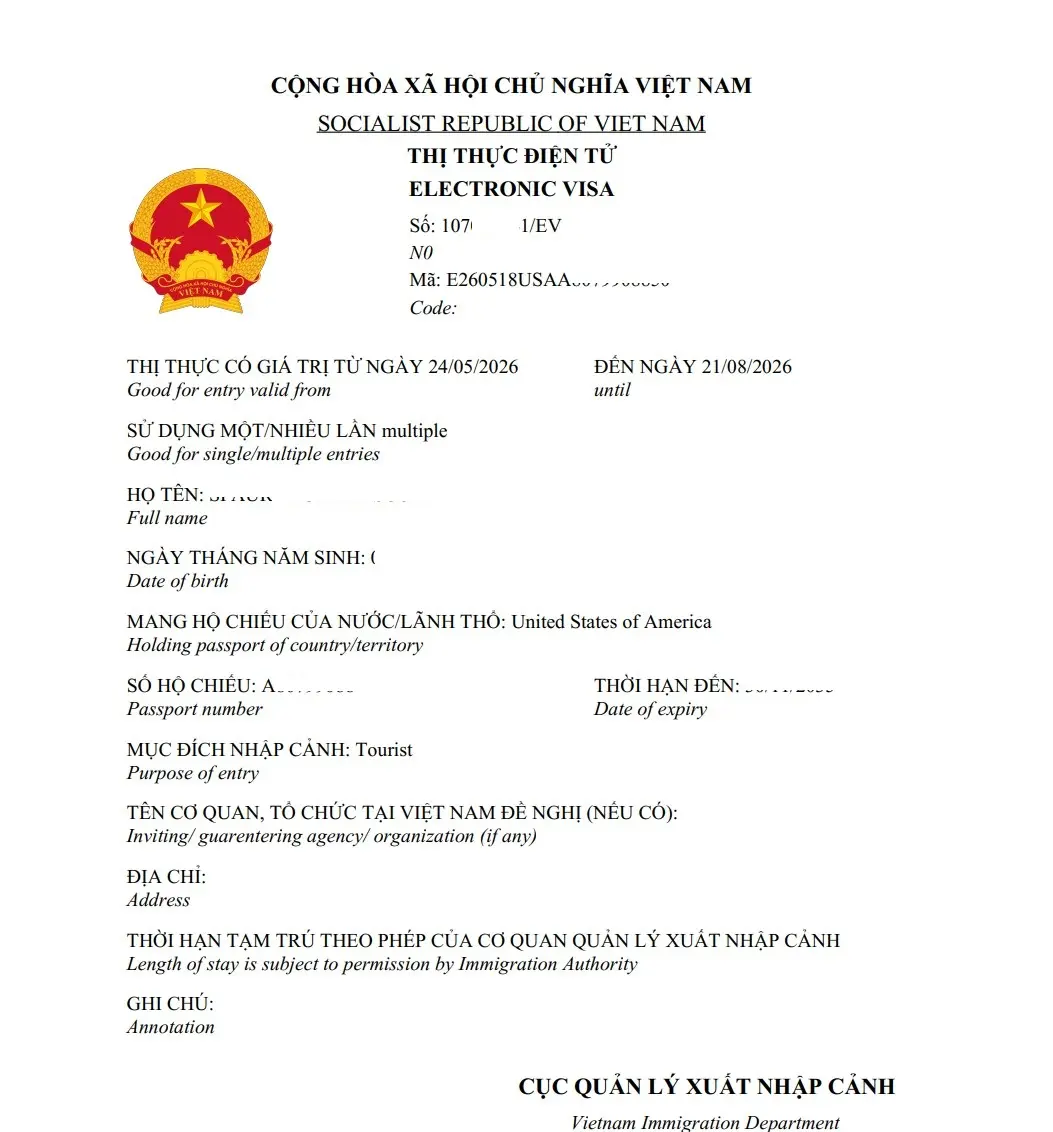
The e-visa is a government-issued electronic visa applied for on evisa.gov.vn or through a visa agency. US passport holders are eligible for both single and multiple entry, with validity up to 90 days. Choose multiple entry if your trip includes a side visit to Cambodia, Laos, or elsewhere in the region before you return to Vietnam, since a single-entry e-visa closes the moment you exit the country.
Single-entry vs multiple-entry e-visa
- Single entry: valid for one arrival and one departure within the 90-day window. Fee: USD 25.
- Multiple entry: allows unlimited crossings within the 90-day window. Fee: USD 50.
Pick single entry for a straightforward Vietnam-only trip. Pick multiple entry if your itinerary loops back into Vietnam after a side trip elsewhere in Southeast Asia, since re-entering on a single-entry e-visa is not possible once you have exited.
Entry and exit ports for the e-visa
The e-visa is accepted at 13 international airports, 16 land border gates, and 13 seaports across Vietnam. Check that your planned port of entry and exit appears on the current list before you apply, since a small number of smaller land border gates do not accept e-visa holders even though they accept visa on arrival or an embassy-issued sticker. You must also enter and exit Vietnam on the same passport used for the e-visa application, and any domestic travel within Vietnam should be done on that same passport.
What documents do US citizens need to apply?
You will need the following documents ready before you start the application:
- A US passport valid for at least 6 months beyond your exit date from Vietnam, with at least 2 blank pages.
- A clear scan of your passport bio page, showing the ICAO lines at the bottom.
- A passport-style photo, 4x6cm, white background, no glasses.
- A valid credit or debit card for the government fee and any service fee.
- A temporary address in Vietnam, such as a hotel booking or the address of family or friends, to enter on the application form.
How to apply for a Vietnam e-visa from the United States
- Submit the online application form with your passport and photo scans.
- Pay the government fee (and the service fee, if using an agency).
- Receive the approval letter by email once the application is processed, then print it for your trip.
Note: Standard processing takes 3-5 working days. Since only one US departure city has a nonstop flight to Vietnam, most travelers are already booking a connection, so apply at least 2 weeks before departure to leave room for both the visa and any flight changes.
How much does a Vietnam visa cost for US citizens?
The government fee is fixed regardless of where you apply; what changes between methods is whether a service fee is added for faster handling.
| Method | Government fee | Processing time |
|---|---|---|
| E-visa (standard) | USD 25-50 | 3-5 working days |
| E-visa (urgent, via agency) | USD 25-50 + service fee | 2.5 hours - 2 working days |
| Visa on arrival | USD 25-50 (stamping fee, cash) | Same-day, on landing |
| Embassy visa | Varies by visa type | Typically 3-5 working days |
The Vietnam visa for United States citizens costs the same government fee no matter which of the three methods you choose; only the service fee for faster handling changes. Keep the government fee and the service fee separate in your budgeting: the government fee is what Vietnam's Immigration Department charges for the visa itself, while the service fee is what an agency like vietnamvisa.com charges on top for checking your documents, submitting the form correctly, and delivering the approval letter faster than the standard queue. See the full e-visa fee table for every speed tier and entry type.
How long does Vietnam e-visa processing take for US citizens?
If your flight is only days away, vietnamvisa.com offers a Super Urgent tier that delivers the approval letter in as little as 2.5 hours, alongside faster same-day and 1-day options. Every application through vietnamvisa.com is backed by a money-back guarantee: the government fee is non-refundable at the Immigration Department, but if you apply through vietnamvisa.com and your application is declined, we refund 100% of what you paid, including the government fee, as our money-back guarantee. This does not cover declines caused by incorrect information you supplied.
Visit www.vietnamvisa.com to apply for the Urgent Vietnam E-Visa and choose the processing speed that matches your travel date.
Vietnam visa on arrival and embassy visa for US citizens
Visa on arrival works only for air travel. You apply online for a pre-approval letter, then present it at the visa counter on landing, where you pay the visa stamping fee in cash and get the visa stamped into your passport.
Note: Since most US travelers connect through a third country to reach Vietnam, check that your final arrival airport has a Vietnamese visa counter before choosing this option; otherwise, use the e-visa instead.
For travelers who prefer a visa sticker arranged before departure, the Vietnamese Embassy in Washington DC and its two consulates issue visas directly to US citizens. This route generally takes longer than the e-visa and calls for an in-person visit or a mailed application, so it suits travelers with weeks of lead time rather than a trip that is days away.
Vietnamese Embassy and Consulates in the United States
Unlike many nationalities, US citizens can choose from three Vietnamese diplomatic offices depending on where they live:
- Embassy (Washington, DC): 1233 20th Street NW, Suite 400, Washington, DC 20036. Phone: (202) 861-0737.
- Consulate General (San Francisco): 1700 California Street, Suite 580, San Francisco, CA 94109. Phone: (415) 922-1707.
- Consulate General (Houston): 5251 Westheimer Road, Suite 1100, Houston, TX 77056. Phone: (713) 850-1233.
Note: Office hours follow standard US business hours on weekdays; call ahead to confirm current hours and any appointment requirement before visiting in person.
Which consulate serves your state
Each office generally handles applicants from a different part of the country, though all three can often process visas for applicants nationwide if you apply by mail. As a rough guide: the Houston consulate typically serves the South and Southwest, the San Francisco consulate typically serves the West Coast and Pacific states, and the Washington DC embassy typically serves the East Coast, Midwest, and everywhere else. If you plan to apply in person rather than by mail, call the office nearest you first to confirm it covers your state and to check its current appointment process, since jurisdiction boundaries and walk-in policies can change.
Flights from the United States to Vietnam and why timing matters
Only one nonstop route currently connects the two countries: San Francisco to Ho Chi Minh City on Vietnam Airlines, a roughly 15-hour 40-minute flight operating 4 times a week. Every other US departure city, including Los Angeles, requires a connection, commonly through Incheon, Tokyo Narita, Taipei, or Hong Kong, with total travel time often exceeding 18 hours once the layover is counted.
This routing matters for one practical reason: if a connecting flight is delayed or rebooked, your arrival date can shift by a full day. Build a buffer into your e-visa application date rather than timing it to your original itinerary exactly, since a missed connection is harder to recover from when nonstop options are this limited. If your departure city is not San Francisco, compare connection times through different hubs before booking, since a shorter total travel time can matter more than a cheaper fare for a trip this long.
See our guide to the urgent Vietnam e-visa if a rebooked connection leaves you with only a day or two before you land in Vietnam.
Is Phu Quoc Island visa-free for US citizens?
Yes, but only under narrow conditions. US citizens flying directly into Phu Quoc Island and staying there for up to 30 days do not need a visa for that stay. The moment your itinerary includes travel to mainland Vietnam, whether before or after the Phu Quoc leg, this exemption no longer applies and you need a standard visa through one of the three routes above.
Travelers sometimes book a Phu Quoc-only holiday assuming the exemption covers a side trip to Ho Chi Minh City or Hanoi as well. It does not. Confirm your full itinerary before deciding whether you qualify for the Phu Quoc exception or need to apply for a visa in advance.
Common reasons Vietnam e-visa applications get delayed for US citizens
Most delays trace back to a handful of avoidable mistakes rather than eligibility problems. Passport photos that do not match the 4x6cm, white background, no glasses spec are the most frequent cause of rejection or resubmission. A passport bio page scan with glare or cropped ICAO lines is the second most common issue.
Name mismatches between the passport and the payment card, and passport validity that falls short of the 6-month requirement at the time of exit rather than the application date, round out the top causes. Entering the wrong port of entry or exit, one that does not accept e-visa holders, is also common among travelers routing through a smaller land border. Checking these four items before you submit removes most of the risk of a delayed approval letter.
Processing also runs slower than usual around Tet, Vietnam's Lunar New Year, when government offices operate on a reduced schedule for about a week. If your travel dates fall in late January or February, apply earlier than the standard 2-week buffer, since the same 3-5 working day estimate can stretch out when the queue backs up ahead of the holiday.
What happens if your Vietnam e-visa application is declined?
A Vietnam visa for United States citizens can be declined for a fixable reason, and a decline does not necessarily mean you cannot travel. Vietnam's Immigration Department states a reason for most declines, and many of them, such as a blurry photo or an unreadable passport scan, can be corrected and resubmitted before your travel date. The government fee for a declined application is non-refundable at the Immigration Department regardless of who submitted it.
If you applied through vietnamvisa.com, the money-back guarantee covers this outcome: you get a full refund of what you paid, including the government fee, unless the decline traced back to incorrect information you supplied yourself. This is worth knowing before you apply, since it removes the financial risk of a first-time rejection for an otherwise eligible traveler.
Frequently Asked Questions
Yes, US citizens must obtain a valid visa to enter Vietnam for any purpose, including tourism, business, or family visits. No visa exemption applies to American passport holders, except at Phu Quoc Island.
Standard e-visa processing takes 3-5 working days. Urgent services through vietnamvisa.com can reduce this to as little as 2.5 hours.
Yes, for air travel only. You need a pre-approved approval letter and pay the visa stamping fee in cash at the airport counter on landing.
The government fee is USD 25 for single entry or USD 50 for multiple entry. Urgent processing adds a service fee on top.
The Vietnamese Embassy is in Washington, DC, with additional consulates in San Francisco and Houston serving different regions of the country.
Yes. Apply on vietnamvisa.com for the Urgent Vietnam E-Visa, with options from same-day down to 2.5 hours, useful given how limited nonstop flight options are between the two countries.
Only one: San Francisco to Ho Chi Minh City on Vietnam Airlines, about 15 hours 40 minutes. Every other US departure city requires a connection, typically through Incheon, Tokyo, Taipei, or Hong Kong.
Yes, for direct arrivals staying up to 30 days on the island only. Any travel to mainland Vietnam before or after removes the exemption and requires a standard visa.